Top 10 Curve Dental Alternatives For Your Business in 2026



Are you looking to switch from Curve Dental or just see what else is out there? If you love Curve’s clean, cloud-first UI and minimal IT work but feel boxed in by add-on costs, integration depth or reporting that doesn’t go as far as you would like, you are not alone. Many practices choose Curve for simplicity and fast onboarding, then outgrow it as they add locations, standardize SOPs or need richer reviews, texting, webchat, online booking and analytics.
In this guide, I will walk you through the 10 best Curve Dental alternatives. For each competitor, I have written what it does, best-fit scenarios, key features, pros/cons, Pricing and real customer feedback so you can decide fast.
Curve Dental is a pure cloud dental practice management platform that combines scheduling, charting, billing/RCM, patient communications and imaging bridges in a modern, browser-based experience. It is popular with small to mid-sized practices that want to avoid servers, simplify day-to-day workflows and train staff quickly.
Teams pick Curve for its ease of use and low IT overhead. They consider alternatives when they need deeper RCM/reporting, more robust integrations like phones, analytics, specialty tools or expanded engagement beyond built-in reminders and messaging.
| Pros: | Cons: |
|---|---|
| Pure cloud & low IT: No servers to manage; automatic updates and backups | Advanced analytics limits: Deeper cohorting or custom KPIs may require exports/BI |
| Easy to learn: Clean UI, quick onboarding, shorter training time for front-desk and assistants | Integration depth varies: Phones, imaging, and specialty tools may need workarounds |
| Solid core PMS: Scheduling, charting, eClaims/ERAs, forms, reminders in one place | Engagement ceiling: Teams seeking aggressive reviews, webchat→SMS, or campaigns often add a dedicated layer |
| Faster standardization: Templates and roles help keep processes consistent across sites | Pricing creep: Per-location/user fees plus add-ons (texting, eRx, storage) can add up |
| Vendor simplicity: Fewer moving parts than assembling a plugin-heavy stack | DSO governance needs: Very large groups may want more granular controls and reporting than out-of-the-box |
Here is what people say about Curve Dental.
“Almost everything! Reporting is awful and there is no way to run one report that shows all data (production and collections) on the same report, the billing, front desk, and treatment planning modules of the software are also very clunky, outdated, and do not have efficient methods, thus cause a lot of wasted time, paper, and a hindrance to productivity.” - (G2)
“Customer service is horrendous. Can’t load fee guides on time and make no effort to do so despite multiple requests well in advance. Constantly placated by staff that offer no solutions. Year after year the fee guides are not loaded on time. Staff could care less. Expensive for lack of functionality and having to manually input your fees because Curve doesn’t care to meet deadlines. Perio chart is elementary; odontogram looks good but you really can’t chart anything other than restorations and surfaces - everything you need to properly diagnose and record on the odontogram needs to be added by creating a note and drawing - it’s a waste of time; medical history - no log; cannot compare over time - bleeding and exudate require too much effort - who has time to colour in plaque and calculus - why is this even a function? ; estimates on insurance are incorrect; cannot coordinate benefits; everything is on a priority list, but what is a priority really doesn’t improve clinical or business functionality and efficiency.” - (Software Advice)
“Accounting part /billing - errors with overpayment deposits credits” - (Capterra)
You can also read this Reddit thread where the person asked for a review about this tool.
Advanced analytics needs: Leadership wants deeper cohorting, custom KPIs, and multi-location rollups without exporting to spreadsheets/BI.
Engagement depth: Teams seek stronger reviews, webchat→SMS, two-way texting, and campaigns than built-in tools provide.
Integration fit: Specific phones/VoIP, imaging, or specialty workflows require tighter or more configurable integrations.
Multi-location governance: DSOs want more granular roles, templates, permissions, and cross-site reporting.
Pricing creep: Per-location/user fees plus texting, eRx, storage add-ons can raise TCO as you scale.
Specialty workflows: Orthodontics, pediatrics, or OMS may need specialized templates or features.
Change management preferences: Some teams prefer a single engagement hub or different PMS model to reduce tool sprawl.
What it is:
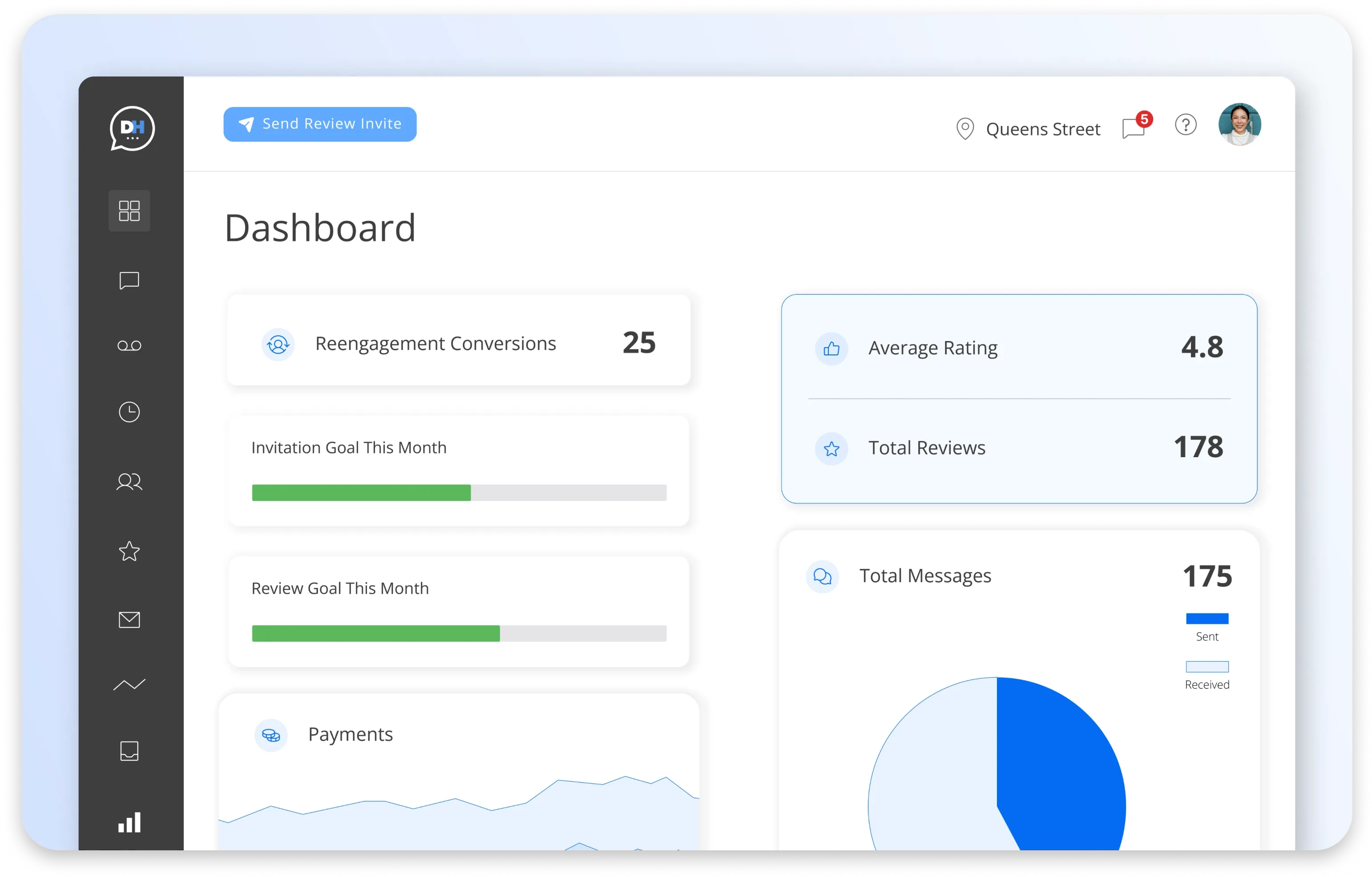
DemandHub is a patient engagement and reputation platform—reviews, two-way texting, webchat→SMS, reminders/recalls, pay-by-text—that layers on top of your existing PMS (including Curve). It’s built to deliver fast growth wins without re-platforming.
Best for: Practices that want growth and communication wins now while keeping Curve for scheduling, charting, and claims.
Key features:
Reviews & reputation: Automated post-visit invites, response tools, on-site widgets.
Two-way SMS & unified inbox: Templates, routing, internal notes, after-hours handling.
Webchat→SMS lead capture: Convert site visitors and keep the conversation in text.
Reminders & recalls: Multi-channel confirmations, no-show sequences, recall nudges.
Pay-by-text: Quick links and receipts to speed collections.
Multi-location controls: Shared templates, location routing, and roll-up reporting.
Integrations: Works alongside Curve and popular VoIP/phone systems.
| Pros: | Cons: |
|---|---|
| Fast ROI on reviews, response times, and schedule utilization | Another vendor to govern (security/BAA, billing) |
| Lighter lift than a full PMS switch—front desk adopts quickly | Possible feature overlap with Curve’s native reminders—audit to avoid redundancy |
| Tool consolidation for comms (SMS, chat, reviews) in one dashboard | Integration depth varies by phone/PMS stack—verify your exact workflows |
Pricing: Tiered per-location subscription; confirm SMS/usage, onboarding, and support SLAs.
What it is:
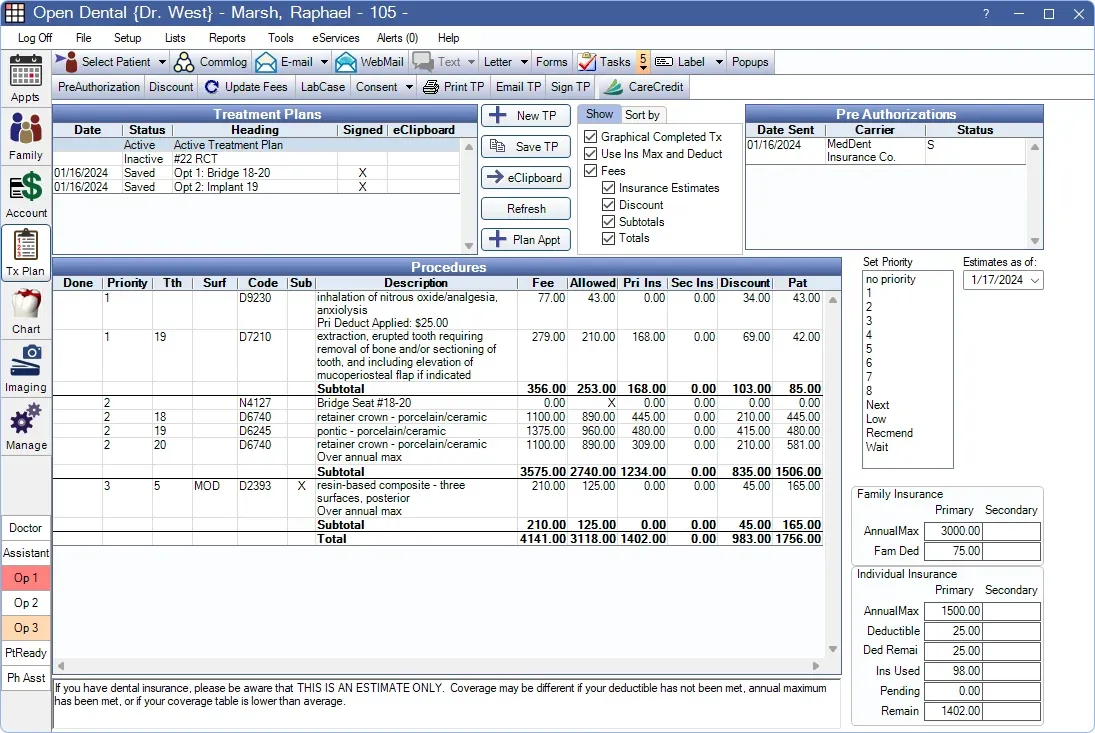
Open Dental is a highly customizable dental PMS, traditionally self-hosted (many use managed cloud hosting). It’s known for transparent licensing, robust RCM, and a large plugin/community ecosystem.
Best for: Practices that value control and customization over an all-in-one cloud experience.
Key features:
Comprehensive charting, perio, treatment planning, eRx
Claims/ERA, AR workflows, payment plans, fee schedule control
Custom forms/templates, query/report tools, CSV export to BI
Broad marketplace of plugins (phones, imaging, engagement, analytics)
APIs/data access; active community and documentation
| Pros: | Cons: |
|---|---|
| Customizable & extensible—tune workflows precisely to your ops | IT/hosting overhead vs. Curve’s zero-server approach |
| Value-forward licensing/support; easy data access | Potential plugin sprawl if governance is loose |
| Ecosystem depth and a large pool of experienced admins/consultants | Advanced analytics may still need external BI or paid add-ons |
Pricing: Transparent per-provider licensing + optional support; hosting and add-ons priced separately.
What it is:
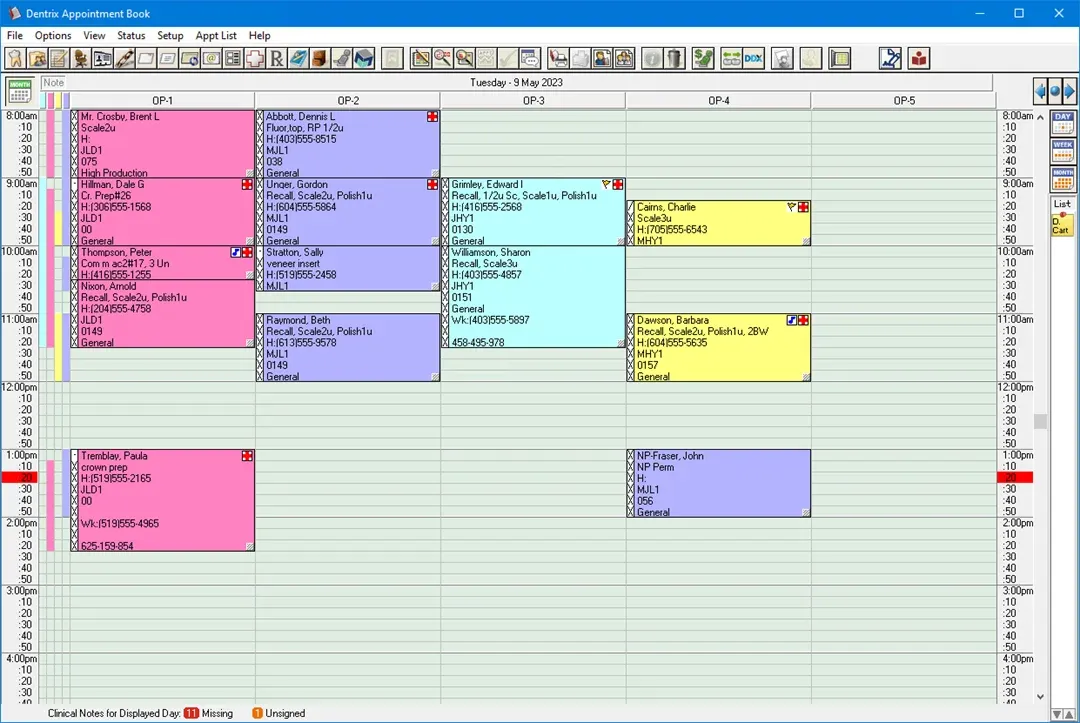
Dentrix is a widely adopted on-premise dental PMS (separate from the cloud product Dentrix Ascend) known for mature, well-documented workflows and deep imaging interoperability, supported by a large marketplace of add-ons and experienced admins.
Best for: Practices prioritizing imaging depth and local control that are comfortable running on-prem infrastructure.
Key features:
Appointment book, charting, treatment planning, eRx
Insurance/claims, ERA/EOB posting, AR workflows
Extensive imaging bridges to leading radiography suites
Fee schedules, clinical templates, reporting and add-on marketplace
| Pros: | Cons: |
|---|---|
| Mature ecosystem with many trained admins and third-party tools | Server/IT management (backups, patches, hardware lifecycle) vs. Curve’s zero-server model |
| Strong imaging interoperability and familiar clinical/billing flows | Multi-location centralization is heavier than in cloud-native PMS |
| Long market history and abundant training materials | Often requires multiple add-ons to match modern comms/marketing features |
Pricing: Per-license + maintenance/support; budget for hardware/IT and paid add-ons (comms, analytics, imaging modules).
What it is:
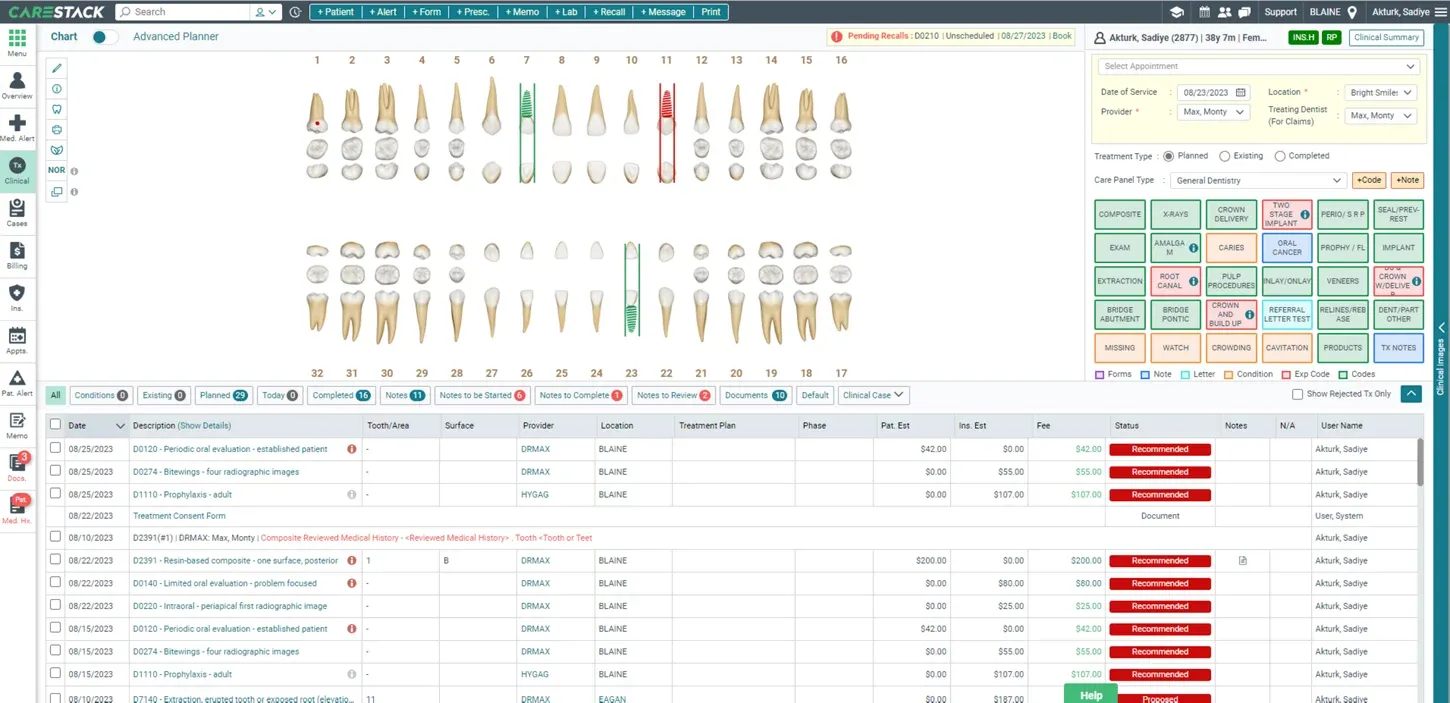
CareStack is a cloud-based, all-in-one PMS/EHR that combines scheduling, charting, RCM, patient communications, and analytics—built to standardize workflows and centralize control across single or multi-location practices.
Best for: Practices and DSOs seeking consolidation + governance with robust RCM in a cloud suite.
Key features:
Scheduling, charting, treatment planning, eRx
Digital forms, two-way texting, reminders/recalls, basic reviews
RCM: eligibility, e-claims, ERA/EOB auto-posting, denial work queues
Analytics (production/collections, AR, no-shows) with role-based dashboards
Multi-location admin: shared templates/fees, granular permissions
Integrations for imaging, VoIP/phones, payments
| Pros: | Cons: |
|---|---|
| All-in-one reduces tool sprawl and vendor coordination | Heavier implementation than Curve; migration/training effort required |
| Cloud-native with SLAs, backups, and continuous updates | Pricing complexity (per location/user + modules like texting/eRx/analytics) |
| RCM depth and multi-location controls suited to growing groups | May feel overpowered for very small, simple practices |
| Clear path to standardized SOPs across sites | Verify integration depth for specific imaging/phone stacks |
Pricing: Subscription per location and/or user; confirm included modules, onboarding, and support SLAs.
What it is:
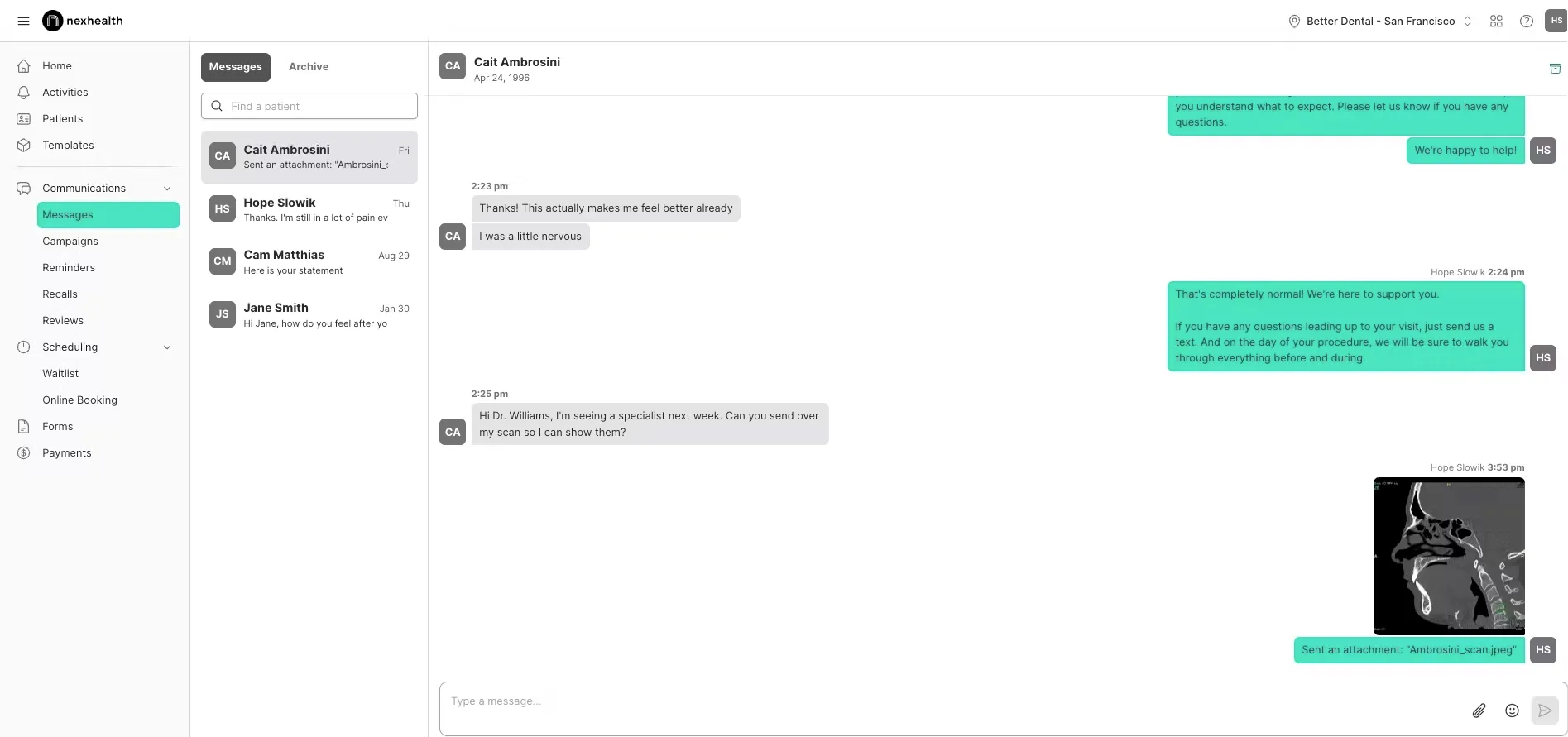
NexHealth is a patient experience and integration layer that adds real-time online booking, digital forms, two-way texting, and payments on top of your existing PMS—so you can modernize access and communication without replacing Curve.
Best for: Practices prioritizing modern access and patient flows without changing PMS.
Key features:
Real-time online booking with provider/insurance rules
Digital forms (medical history, consents) that sync back to PMS
Two-way SMS, confirmations, recalls
Payments (pay-by-text, deposits)
APIs & integrations with major PMS platforms
Analytics on conversions, no-show reduction, and engagement
| Pros: | Cons: |
|---|---|
| Exceptional booking UX that reduces phone tag and boosts new-patient conversion | It’s an additional vendor alongside Curve |
| Developer-friendly APIs for custom flows at scale | Integration depth varies—verify bi-directional sync and insurance guardrails |
| Quick wins on access, reminders, and paperless intake | Possible overlap with Curve’s native comms |
Pricing: Tiered per-location subscription; confirm SMS/usage, onboarding, and support tiers.
What it is:
Demandforce is a patient communication, reviews, and marketing platform that sits on top of your PMS. It’s designed to increase appointments through automated reminders/recalls, review generation, and reactivation campaigns—without replacing Curve.
Best for: Clinics focused on reputation growth, patient reactivation, and schedule utilization without changing Curve.
Key features:
Automated reminders & recalls (SMS/email) with configurable cadences
Review generation & reputation widgets and monitoring
Reactivation campaigns for overdue hygiene and unscheduled treatment
Two-way texting with a unified inbox
Performance dashboards for appointment yield and reputation trends
Integrations with Curve and other major dental PMS platforms
| Pros: | Cons: |
|---|---|
| Fast, marketing-led ROI via reviews and schedule fill | Possible feature overlap with Curve’s native comms—audit to avoid redundancy |
| Consolidates comms + basic marketing to reduce tool sprawl | Integration depth varies; confirm field mapping and sync timing |
| Easy to standardize templates across multi-location groups | Not a replacement for PMS/RCM functionality |
Pricing: Tiered per-location subscription; verify inclusions (SMS volume, onboarding, support SLAs).
What it is:
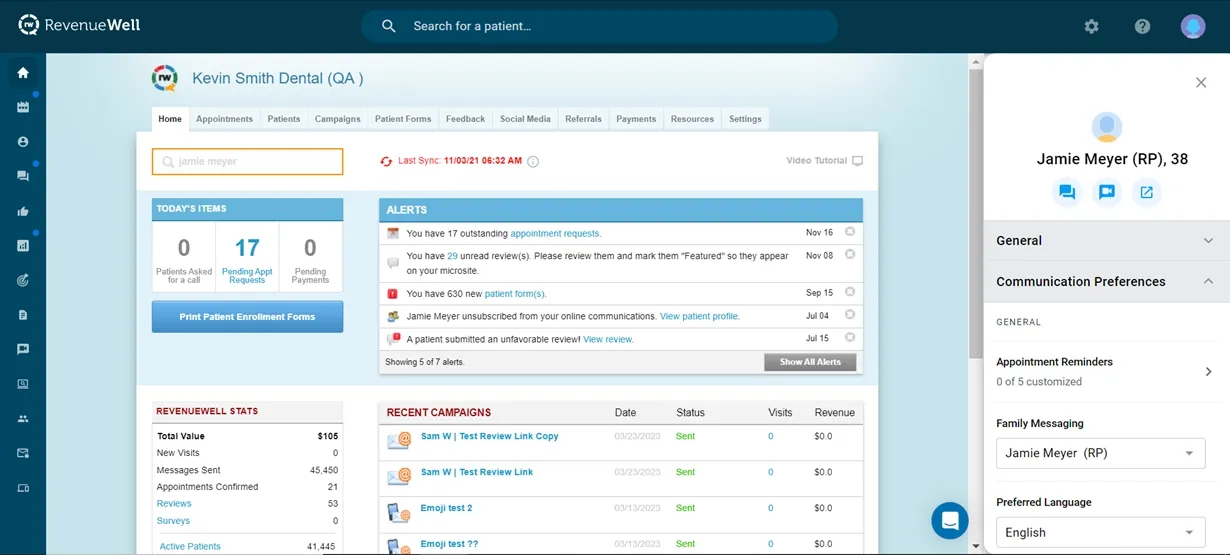
RevenueWell is a patient communication & marketing automation suite—reminders, recalls, segmented email/SMS campaigns, newsletters, and reviews—that layers on top of your PMS to drive production, retention, and reactivation without replacing Curve.
Best for: Growth-focused teams that want marketing-grade automation to lift recalls, reactivations, and production—without a PMS change.
Key features:
Automated reminders & recalls with flexible cadences
Email/SMS campaigns with segmentation and reusable templates
Review requests & reputation monitoring
Newsletters & education content to nurture patients
Reporting dashboards on campaign performance and response
Integrations with Curve and other major dental PMSs
| Pros: | Cons: |
|---|---|
| Strong segmentation and automation for targeted outreach | Potential overlap with Curve’s native comms—audit to avoid redundancy |
| Helps reactivate overdue patients and fill the schedule | Integration depth varies; verify field sync (due/overdue logic, treatment status) |
| Reduces manual front-desk follow-ups with repeatable campaigns | Another vendor to manage (contracts, support, security) |
Pricing: Tiered per-location subscription; confirm SMS/usage, onboarding, and support SLAs.

What it is:
Solutionreach is a patient relationship & communications platform for reminders, recalls, two-way texting, surveys, newsletters, education, and reputation—deployed alongside your PMS to scale outreach without replacing Curve.
Best for: Larger practices and DSOs that need scalable, standardized communications beyond basic reminders.
Key features:
Automated reminders & recalls with flexible cadences
Two-way SMS and broadcast messaging
Surveys & patient education content libraries
Newsletters & outreach with audience targeting
Reputation prompts and monitoring
Centralized controls for multi-location consistency
Dashboards & reporting on engagement and appointment yield
| Pros: | Cons: |
|---|---|
| Mature, comprehensive comms feature set for large orgs | Can feel heavy for single-site clinics |
| Strong standardization & governance across locations | Potential overlap with Curve’s native comms—avoid redundancy |
| Supports reactivation and education at scale | Integration depth varies; verify status fields and due/overdue logic |
Pricing: Tiered/enterprise per-location plans; clarify onboarding, training, and SLAs.
What it is:
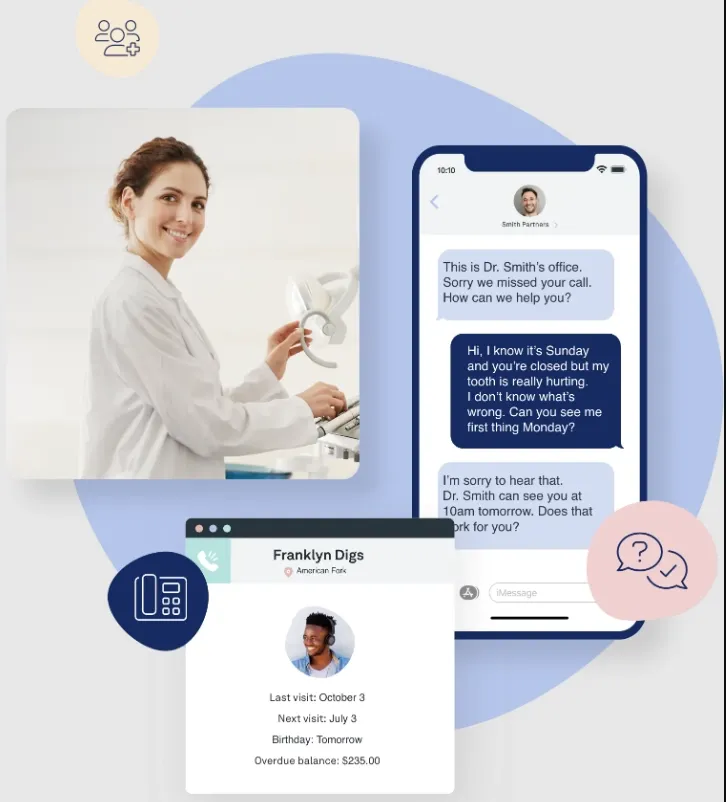
Weave combines VoIP phones with patient messaging—call-pop, two-way SMS, reminders, reviews, and pay-by-text—to streamline front-desk communications while Curve remains your PMS/RCM.
Best for: Practices modernizing phones + messaging together to cut front-desk friction.
Key features:
VoIP & call-pop (patient details at inbound call)
Two-way texting with canned replies and shared inbox
Automated reminders & review requests
Pay-by-text links for quick collections
Reporting for missed-call rate, response time, review velocity
Integrations with Curve and popular phone systems (depth varies)
| Pros: | Cons: |
|---|---|
| Improves speed-to-answer and first-contact resolution with call-pop + SMS handoff | Number porting/hardware planning and change management required |
| Reduces missed calls and phone tag; unifies comms channels for the front desk | Possible overlap with Curve’s reminders/reviews—avoid redundancy |
| Practical all-in-one phones + messaging approach | Integration depth varies—confirm call-pop field mapping and sync behavior |
Pricing: Per-line/per-location subscription; confirm hardware, porting, and SMS usage costs.
What it is:
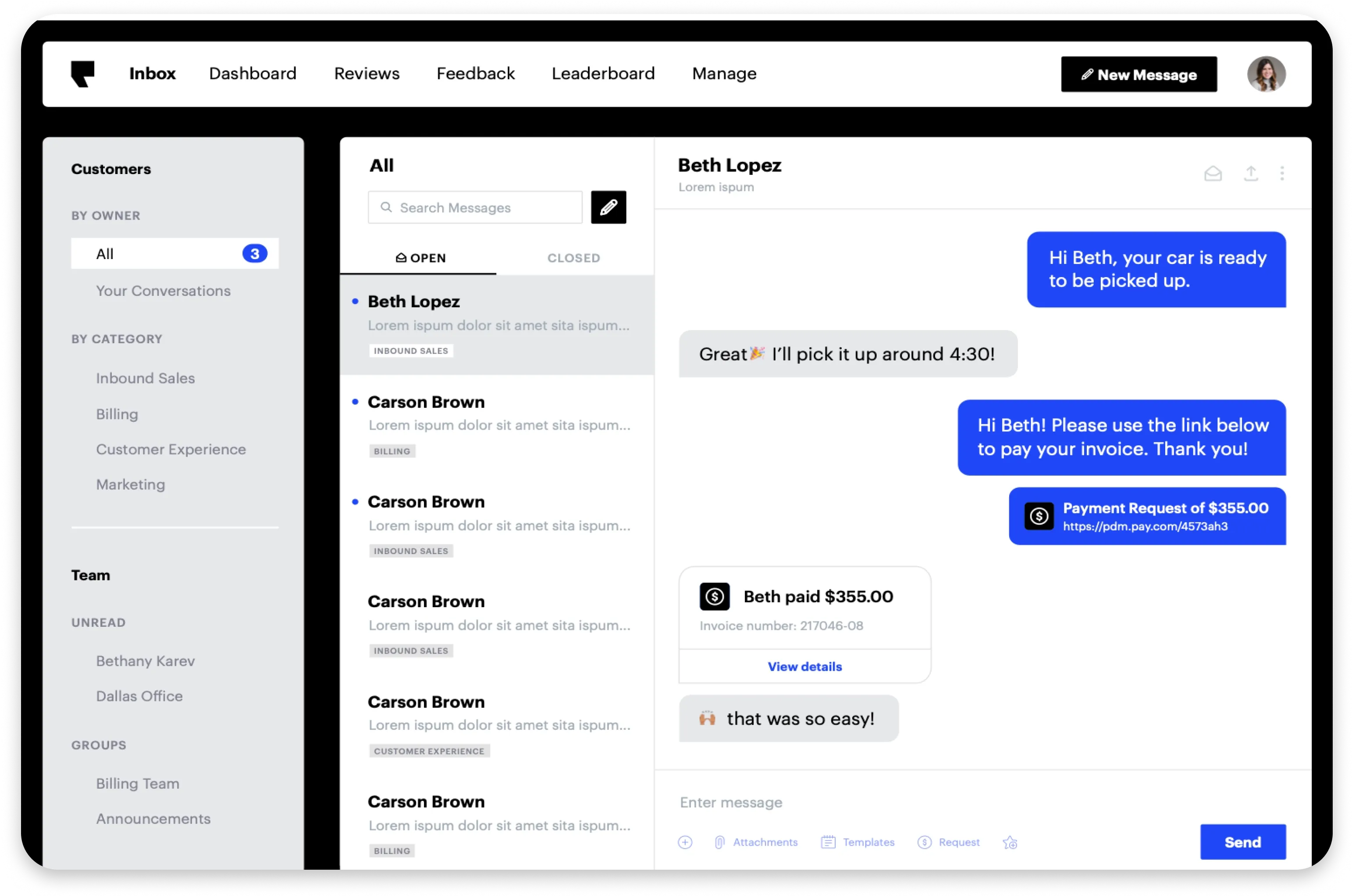
Podium is a messaging, reviews, webchat, and payments platform built to boost local reputation and convert website visitors—layered on top of Curve so you don’t have to change PMS.
Best for: Clinics focused on reputation growth and lead capture without replacing Curve.
Key features:
Review invites/management with Google/Facebook integrations and on-site widgets
Webchat → SMS lead capture and handoff to a unified inbox
Two-way texting and quick-reply templates
Pay-by-text and simple collections flows
Reporting on response times, review velocity, and chat conversion
Integrations with popular dental PMS/CRMs (depth varies)
| Pros: | Cons: |
|---|---|
| Local SEO lift via consistent, high-velocity reviews | Possible overlap with Curve’s reminders/reviews—audit to avoid redundancy |
| Faster lead response with chat-to-text and consolidated messaging | Integration depth differs by setup; confirm patient/appointment sync |
| Easy adoption for front-desk teams | Another vendor to manage (security review, contracts, support) |
Pricing: Tiered per-location subscription; usage (SMS volume), payments, and add-ons can affect cost.
Core Type: Engagement layer
Best For: Reviews, texting, webchat without PMS swap
Key Strengths: Fast wins on reviews/no-shows; unified inbox; pay-by-text
Potential Drawbacks: Another vendor; not PMS/RCM
Pricing: Per-location tiers; usage add-ons
Notable Integrations: Sync with Curve, Google/FB, VoIP
Core Type: PMS (self/managed-hosted)
Best For: Flexibility, cost control
Key Strengths: Customizable; big community; strong RCM basics
Potential Drawbacks: IT/hosting overhead; plugin sprawl risk
Pricing: Per-provider + support
Notable Integrations: Plugins, phones, analytics
Core Type: PMS (on-prem)
Best For: Imaging depth, traditional stacks
Key Strengths: Mature ecosystem; many trained admins
Potential Drawbacks: Server/IT upkeep; add-ons for comms
Pricing: License + support
Notable Integrations: Imaging suites, eRx, add-ons
Core Type: PMS (cloud, all-in-one)
Best For: DSO governance & fewer plugins
Key Strengths: Built-in comms + RCM depth; centralized control
Potential Drawbacks: Heavier implementation; pricing complexity
Pricing: Per location/user + modules
Notable Integrations: Imaging/VoIP/payments
Core Type: Engagement/API layer
Best For: Real-time booking + forms
Key Strengths: Best-in-class booking UX; developer-friendly APIs
Potential Drawbacks: Overlap with PMS comms; sync depth varies
Pricing: Per-location tiers
Notable Integrations: Major PMS sync, payments
Core Type: Engagement/marketing
Best For: Reviews + reactivation
Key Strengths: Reputation widgets; automated campaigns
Potential Drawbacks: Overlap with Curve comms
Pricing: Per-location tiers
Notable Integrations: Curve sync, web widgets
Core Type: Engagement/marketing
Best For: Lifecycle marketing & campaigns
Key Strengths: Segmentation, newsletters, automation
Potential Drawbacks: Integration variance; another vendor
Pricing: Per-location tiers
Notable Integrations: Curve sync, email/SMS
Core Type: Engagement/comms
Best For: Enterprise-scale outreach
Key Strengths: Standardization; surveys; education
Potential Drawbacks: Can feel heavy for small clinics
Pricing: Tiered/enterprise
Notable Integrations: Curve sync, surveys
Core Type: Phones + comms
Best For: VoIP + SMS + payments
Key Strengths: Call-pop; unified phones/SMS
Potential Drawbacks: Porting/hardware; overlap with comms
Pricing: Per-line/location
Notable Integrations: Curve screen-pop, payments
Core Type: Messaging, reviews, chat
Best For: Local SEO + lead capture
Key Strengths: Webchat→SMS; review velocity
Potential Drawbacks: Integration depth differs
Pricing: Per-location tiers
Notable Integrations: Google/FB, PMS/CRM hooks
If you want to keep Curve Dental for core PMS/RCM but level up patient engagement fast, choose DemandHub: it stacks on top of Curve to drive more Google reviews, unify two-way texting in a single inbox, convert web traffic via webchat→SMS, cut no-shows with smarter reminders/recalls, and enable pay-by-text—delivering visible wins (reviews, response times, reactivations) in weeks with far less disruption than a full PMS switch.
Switching from Curve Dental to DemandHub is super straightforward, and you won’t have to lift a finger. The customer support team at DemandHub will take care of everything for you.
Thinking about making the switch?
Book your free DemandHub demo and see how it compares to Curve Dental for your practice.
Are you looking to switch from Curve Dental or just see what else is out there? If you love Curve’s clean, cloud-first UI and minimal IT work but feel boxed in by add-on costs, integration depth or reporting that doesn’t go as far as you would like, you are not alone. Many practices choose Curve for simplicity and fast onboarding, then outgrow it as they add locations, standardize SOPs or need richer reviews, texting, webchat, online booking and analytics.
In this guide, I will walk you through the 10 best Curve Dental alternatives. For each competitor, I have written what it does, best-fit scenarios, key features, pros/cons, Pricing and real customer feedback so you can decide fast.
Curve Dental is a pure cloud dental practice management platform that combines scheduling, charting, billing/RCM, patient communications and imaging bridges in a modern, browser-based experience. It is popular with small to mid-sized practices that want to avoid servers, simplify day-to-day workflows and train staff quickly.
Teams pick Curve for its ease of use and low IT overhead. They consider alternatives when they need deeper RCM/reporting, more robust integrations like phones, analytics, specialty tools or expanded engagement beyond built-in reminders and messaging.
| Pros: | Cons: |
|---|---|
| Pure cloud & low IT: No servers to manage; automatic updates and backups | Advanced analytics limits: Deeper cohorting or custom KPIs may require exports/BI |
| Easy to learn: Clean UI, quick onboarding, shorter training time for front-desk and assistants | Integration depth varies: Phones, imaging, and specialty tools may need workarounds |
| Solid core PMS: Scheduling, charting, eClaims/ERAs, forms, reminders in one place | Engagement ceiling: Teams seeking aggressive reviews, webchat→SMS, or campaigns often add a dedicated layer |
| Faster standardization: Templates and roles help keep processes consistent across sites | Pricing creep: Per-location/user fees plus add-ons (texting, eRx, storage) can add up |
| Vendor simplicity: Fewer moving parts than assembling a plugin-heavy stack | DSO governance needs: Very large groups may want more granular controls and reporting than out-of-the-box |
Here is what people say about Curve Dental.
“Almost everything! Reporting is awful and there is no way to run one report that shows all data (production and collections) on the same report, the billing, front desk, and treatment planning modules of the software are also very clunky, outdated, and do not have efficient methods, thus cause a lot of wasted time, paper, and a hindrance to productivity.” - (G2)
“Customer service is horrendous. Can’t load fee guides on time and make no effort to do so despite multiple requests well in advance. Constantly placated by staff that offer no solutions. Year after year the fee guides are not loaded on time. Staff could care less. Expensive for lack of functionality and having to manually input your fees because Curve doesn’t care to meet deadlines. Perio chart is elementary; odontogram looks good but you really can’t chart anything other than restorations and surfaces - everything you need to properly diagnose and record on the odontogram needs to be added by creating a note and drawing - it’s a waste of time; medical history - no log; cannot compare over time - bleeding and exudate require too much effort - who has time to colour in plaque and calculus - why is this even a function? ; estimates on insurance are incorrect; cannot coordinate benefits; everything is on a priority list, but what is a priority really doesn’t improve clinical or business functionality and efficiency.” - (Software Advice)
“Accounting part /billing - errors with overpayment deposits credits” - (Capterra)
You can also read this Reddit thread where the person asked for a review about this tool.
Advanced analytics needs: Leadership wants deeper cohorting, custom KPIs, and multi-location rollups without exporting to spreadsheets/BI.
Engagement depth: Teams seek stronger reviews, webchat→SMS, two-way texting, and campaigns than built-in tools provide.
Integration fit: Specific phones/VoIP, imaging, or specialty workflows require tighter or more configurable integrations.
Multi-location governance: DSOs want more granular roles, templates, permissions, and cross-site reporting.
Pricing creep: Per-location/user fees plus texting, eRx, storage add-ons can raise TCO as you scale.
Specialty workflows: Orthodontics, pediatrics, or OMS may need specialized templates or features.
Change management preferences: Some teams prefer a single engagement hub or different PMS model to reduce tool sprawl.
What it is:
DemandHub is a patient engagement and reputation platform—reviews, two-way texting, webchat→SMS, reminders/recalls, pay-by-text—that layers on top of your existing PMS (including Curve). It’s built to deliver fast growth wins without re-platforming.
Best for: Practices that want growth and communication wins now while keeping Curve for scheduling, charting, and claims.
Key features:
Reviews & reputation: Automated post-visit invites, response tools, on-site widgets.
Two-way SMS & unified inbox: Templates, routing, internal notes, after-hours handling.
Webchat→SMS lead capture: Convert site visitors and keep the conversation in text.
Reminders & recalls: Multi-channel confirmations, no-show sequences, recall nudges.
Pay-by-text: Quick links and receipts to speed collections.
Multi-location controls: Shared templates, location routing, and roll-up reporting.
Integrations: Works alongside Curve and popular VoIP/phone systems.
| Pros: | Cons: |
|---|---|
| Fast ROI on reviews, response times, and schedule utilization | Another vendor to govern (security/BAA, billing) |
| Lighter lift than a full PMS switch—front desk adopts quickly | Possible feature overlap with Curve’s native reminders—audit to avoid redundancy |
| Tool consolidation for comms (SMS, chat, reviews) in one dashboard | Integration depth varies by phone/PMS stack—verify your exact workflows |
Pricing: Tiered per-location subscription; confirm SMS/usage, onboarding, and support SLAs.
What it is:
Open Dental is a highly customizable dental PMS, traditionally self-hosted (many use managed cloud hosting). It’s known for transparent licensing, robust RCM, and a large plugin/community ecosystem.
Best for: Practices that value control and customization over an all-in-one cloud experience.
Key features:
Comprehensive charting, perio, treatment planning, eRx
Claims/ERA, AR workflows, payment plans, fee schedule control
Custom forms/templates, query/report tools, CSV export to BI
Broad marketplace of plugins (phones, imaging, engagement, analytics)
APIs/data access; active community and documentation
| Pros: | Cons: |
|---|---|
| Customizable & extensible—tune workflows precisely to your ops | IT/hosting overhead vs. Curve’s zero-server approach |
| Value-forward licensing/support; easy data access | Potential plugin sprawl if governance is loose |
| Ecosystem depth and a large pool of experienced admins/consultants | Advanced analytics may still need external BI or paid add-ons |
Pricing: Transparent per-provider licensing + optional support; hosting and add-ons priced separately.
What it is:
Dentrix is a widely adopted on-premise dental PMS (separate from the cloud product Dentrix Ascend) known for mature, well-documented workflows and deep imaging interoperability, supported by a large marketplace of add-ons and experienced admins.
Best for: Practices prioritizing imaging depth and local control that are comfortable running on-prem infrastructure.
Key features:
Appointment book, charting, treatment planning, eRx
Insurance/claims, ERA/EOB posting, AR workflows
Extensive imaging bridges to leading radiography suites
Fee schedules, clinical templates, reporting and add-on marketplace
| Pros: | Cons: |
|---|---|
| Mature ecosystem with many trained admins and third-party tools | Server/IT management (backups, patches, hardware lifecycle) vs. Curve’s zero-server model |
| Strong imaging interoperability and familiar clinical/billing flows | Multi-location centralization is heavier than in cloud-native PMS |
| Long market history and abundant training materials | Often requires multiple add-ons to match modern comms/marketing features |
Pricing: Per-license + maintenance/support; budget for hardware/IT and paid add-ons (comms, analytics, imaging modules).
What it is:
CareStack is a cloud-based, all-in-one PMS/EHR that combines scheduling, charting, RCM, patient communications, and analytics—built to standardize workflows and centralize control across single or multi-location practices.
Best for: Practices and DSOs seeking consolidation + governance with robust RCM in a cloud suite.
Key features:
Scheduling, charting, treatment planning, eRx
Digital forms, two-way texting, reminders/recalls, basic reviews
RCM: eligibility, e-claims, ERA/EOB auto-posting, denial work queues
Analytics (production/collections, AR, no-shows) with role-based dashboards
Multi-location admin: shared templates/fees, granular permissions
Integrations for imaging, VoIP/phones, payments
| Pros: | Cons: |
|---|---|
| All-in-one reduces tool sprawl and vendor coordination | Heavier implementation than Curve; migration/training effort required |
| Cloud-native with SLAs, backups, and continuous updates | Pricing complexity (per location/user + modules like texting/eRx/analytics) |
| RCM depth and multi-location controls suited to growing groups | May feel overpowered for very small, simple practices |
| Clear path to standardized SOPs across sites | Verify integration depth for specific imaging/phone stacks |
Pricing: Subscription per location and/or user; confirm included modules, onboarding, and support SLAs.
What it is:
NexHealth is a patient experience and integration layer that adds real-time online booking, digital forms, two-way texting, and payments on top of your existing PMS—so you can modernize access and communication without replacing Curve.
Best for: Practices prioritizing modern access and patient flows without changing PMS.
Key features:
Real-time online booking with provider/insurance rules
Digital forms (medical history, consents) that sync back to PMS
Two-way SMS, confirmations, recalls
Payments (pay-by-text, deposits)
APIs & integrations with major PMS platforms
Analytics on conversions, no-show reduction, and engagement
| Pros: | Cons: |
|---|---|
| Exceptional booking UX that reduces phone tag and boosts new-patient conversion | It’s an additional vendor alongside Curve |
| Developer-friendly APIs for custom flows at scale | Integration depth varies—verify bi-directional sync and insurance guardrails |
| Quick wins on access, reminders, and paperless intake | Possible overlap with Curve’s native comms |
Pricing: Tiered per-location subscription; confirm SMS/usage, onboarding, and support tiers.
What it is:
Demandforce is a patient communication, reviews, and marketing platform that sits on top of your PMS. It’s designed to increase appointments through automated reminders/recalls, review generation, and reactivation campaigns—without replacing Curve.
Best for: Clinics focused on reputation growth, patient reactivation, and schedule utilization without changing Curve.
Key features:
Automated reminders & recalls (SMS/email) with configurable cadences
Review generation & reputation widgets and monitoring
Reactivation campaigns for overdue hygiene and unscheduled treatment
Two-way texting with a unified inbox
Performance dashboards for appointment yield and reputation trends
Integrations with Curve and other major dental PMS platforms
| Pros: | Cons: |
|---|---|
| Fast, marketing-led ROI via reviews and schedule fill | Possible feature overlap with Curve’s native comms—audit to avoid redundancy |
| Consolidates comms + basic marketing to reduce tool sprawl | Integration depth varies; confirm field mapping and sync timing |
| Easy to standardize templates across multi-location groups | Not a replacement for PMS/RCM functionality |
Pricing: Tiered per-location subscription; verify inclusions (SMS volume, onboarding, support SLAs).
What it is:
RevenueWell is a patient communication & marketing automation suite—reminders, recalls, segmented email/SMS campaigns, newsletters, and reviews—that layers on top of your PMS to drive production, retention, and reactivation without replacing Curve.
Best for: Growth-focused teams that want marketing-grade automation to lift recalls, reactivations, and production—without a PMS change.
Key features:
Automated reminders & recalls with flexible cadences
Email/SMS campaigns with segmentation and reusable templates
Review requests & reputation monitoring
Newsletters & education content to nurture patients
Reporting dashboards on campaign performance and response
Integrations with Curve and other major dental PMSs
| Pros: | Cons: |
|---|---|
| Strong segmentation and automation for targeted outreach | Potential overlap with Curve’s native comms—audit to avoid redundancy |
| Helps reactivate overdue patients and fill the schedule | Integration depth varies; verify field sync (due/overdue logic, treatment status) |
| Reduces manual front-desk follow-ups with repeatable campaigns | Another vendor to manage (contracts, support, security) |
Pricing: Tiered per-location subscription; confirm SMS/usage, onboarding, and support SLAs.
What it is:
Solutionreach is a patient relationship & communications platform for reminders, recalls, two-way texting, surveys, newsletters, education, and reputation—deployed alongside your PMS to scale outreach without replacing Curve.
Best for: Larger practices and DSOs that need scalable, standardized communications beyond basic reminders.
Key features:
Automated reminders & recalls with flexible cadences
Two-way SMS and broadcast messaging
Surveys & patient education content libraries
Newsletters & outreach with audience targeting
Reputation prompts and monitoring
Centralized controls for multi-location consistency
Dashboards & reporting on engagement and appointment yield
| Pros: | Cons: |
|---|---|
| Mature, comprehensive comms feature set for large orgs | Can feel heavy for single-site clinics |
| Strong standardization & governance across locations | Potential overlap with Curve’s native comms—avoid redundancy |
| Supports reactivation and education at scale | Integration depth varies; verify status fields and due/overdue logic |
Pricing: Tiered/enterprise per-location plans; clarify onboarding, training, and SLAs.
What it is:
Weave combines VoIP phones with patient messaging—call-pop, two-way SMS, reminders, reviews, and pay-by-text—to streamline front-desk communications while Curve remains your PMS/RCM.
Best for: Practices modernizing phones + messaging together to cut front-desk friction.
Key features:
VoIP & call-pop (patient details at inbound call)
Two-way texting with canned replies and shared inbox
Automated reminders & review requests
Pay-by-text links for quick collections
Reporting for missed-call rate, response time, review velocity
Integrations with Curve and popular phone systems (depth varies)
| Pros: | Cons: |
|---|---|
| Improves speed-to-answer and first-contact resolution with call-pop + SMS handoff | Number porting/hardware planning and change management required |
| Reduces missed calls and phone tag; unifies comms channels for the front desk | Possible overlap with Curve’s reminders/reviews—avoid redundancy |
| Practical all-in-one phones + messaging approach | Integration depth varies—confirm call-pop field mapping and sync behavior |
Pricing: Per-line/per-location subscription; confirm hardware, porting, and SMS usage costs.
What it is:
Podium is a messaging, reviews, webchat, and payments platform built to boost local reputation and convert website visitors—layered on top of Curve so you don’t have to change PMS.
Best for: Clinics focused on reputation growth and lead capture without replacing Curve.
Key features:
Review invites/management with Google/Facebook integrations and on-site widgets
Webchat → SMS lead capture and handoff to a unified inbox
Two-way texting and quick-reply templates
Pay-by-text and simple collections flows
Reporting on response times, review velocity, and chat conversion
Integrations with popular dental PMS/CRMs (depth varies)
| Pros: | Cons: |
|---|---|
| Local SEO lift via consistent, high-velocity reviews | Possible overlap with Curve’s reminders/reviews—audit to avoid redundancy |
| Faster lead response with chat-to-text and consolidated messaging | Integration depth differs by setup; confirm patient/appointment sync |
| Easy adoption for front-desk teams | Another vendor to manage (security review, contracts, support) |
Pricing: Tiered per-location subscription; usage (SMS volume), payments, and add-ons can affect cost.
Core Type: Engagement layer
Best For: Reviews, texting, webchat without PMS swap
Key Strengths: Fast wins on reviews/no-shows; unified inbox; pay-by-text
Potential Drawbacks: Another vendor; not PMS/RCM
Pricing: Per-location tiers; usage add-ons
Notable Integrations: Sync with Curve, Google/FB, VoIP
Core Type: PMS (self/managed-hosted)
Best For: Flexibility, cost control
Key Strengths: Customizable; big community; strong RCM basics
Potential Drawbacks: IT/hosting overhead; plugin sprawl risk
Pricing: Per-provider + support
Notable Integrations: Plugins, phones, analytics
Core Type: PMS (on-prem)
Best For: Imaging depth, traditional stacks
Key Strengths: Mature ecosystem; many trained admins
Potential Drawbacks: Server/IT upkeep; add-ons for comms
Pricing: License + support
Notable Integrations: Imaging suites, eRx, add-ons
Core Type: PMS (cloud, all-in-one)
Best For: DSO governance & fewer plugins
Key Strengths: Built-in comms + RCM depth; centralized control
Potential Drawbacks: Heavier implementation; pricing complexity
Pricing: Per location/user + modules
Notable Integrations: Imaging/VoIP/payments
Core Type: Engagement/API layer
Best For: Real-time booking + forms
Key Strengths: Best-in-class booking UX; developer-friendly APIs
Potential Drawbacks: Overlap with PMS comms; sync depth varies
Pricing: Per-location tiers
Notable Integrations: Major PMS sync, payments
Core Type: Engagement/marketing
Best For: Reviews + reactivation
Key Strengths: Reputation widgets; automated campaigns
Potential Drawbacks: Overlap with Curve comms
Pricing: Per-location tiers
Notable Integrations: Curve sync, web widgets
Core Type: Engagement/marketing
Best For: Lifecycle marketing & campaigns
Key Strengths: Segmentation, newsletters, automation
Potential Drawbacks: Integration variance; another vendor
Pricing: Per-location tiers
Notable Integrations: Curve sync, email/SMS
Core Type: Engagement/comms
Best For: Enterprise-scale outreach
Key Strengths: Standardization; surveys; education
Potential Drawbacks: Can feel heavy for small clinics
Pricing: Tiered/enterprise
Notable Integrations: Curve sync, surveys
Core Type: Phones + comms
Best For: VoIP + SMS + payments
Key Strengths: Call-pop; unified phones/SMS
Potential Drawbacks: Porting/hardware; overlap with comms
Pricing: Per-line/location
Notable Integrations: Curve screen-pop, payments
Core Type: Messaging, reviews, chat
Best For: Local SEO + lead capture
Key Strengths: Webchat→SMS; review velocity
Potential Drawbacks: Integration depth differs
Pricing: Per-location tiers
Notable Integrations: Google/FB, PMS/CRM hooks
If you want to keep Curve Dental for core PMS/RCM but level up patient engagement fast, choose DemandHub: it stacks on top of Curve to drive more Google reviews, unify two-way texting in a single inbox, convert web traffic via webchat→SMS, cut no-shows with smarter reminders/recalls, and enable pay-by-text—delivering visible wins (reviews, response times, reactivations) in weeks with far less disruption than a full PMS switch.
Switching from Curve Dental to DemandHub is super straightforward, and you won’t have to lift a finger. The customer support team at DemandHub will take care of everything for you.
Thinking about making the switch?
Book your free DemandHub demo and see how it compares to Curve Dental for your practice.